CITIZEN CALL TO CANDIDATES FOR THE PRESIDENTIAL ELECTION OF OCTOBER 12, 2025
Cameroon is currently at a turning point in its history. More than 40% of the population still lives below the poverty line, even though the national wealth has been estimated at more than 27,000 billion CFA francs in
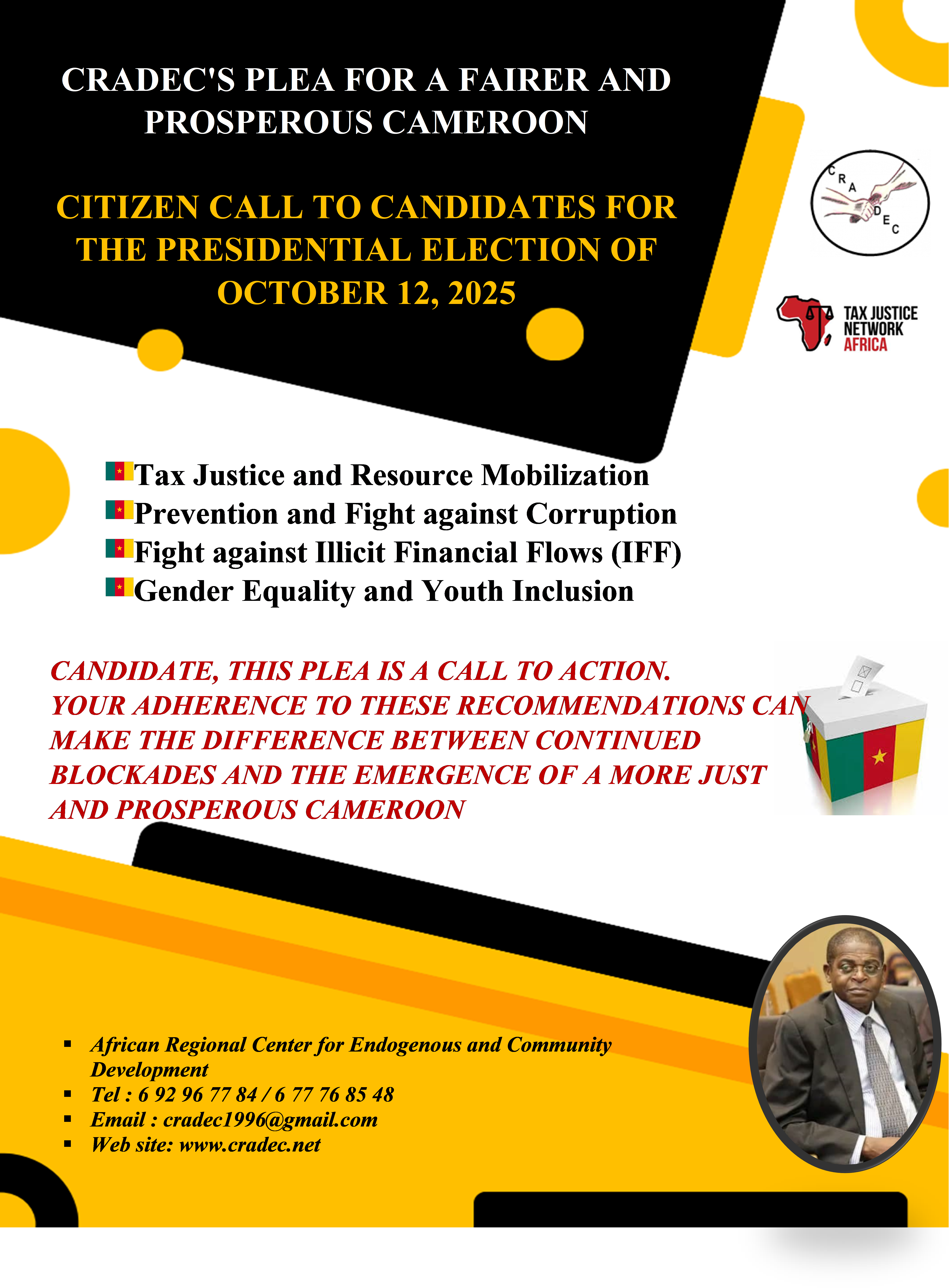
CITIZEN CALL TO CANDIDATES FOR THE PRESIDENTIAL ELECTION OF OCTOBER 12, 2025
Cameroon is currently at a turning point in its history. More than 40% of the population still lives below the poverty line, even though the national wealth has been estimated at more than 27,000 billion CFA francs in GDP by 2023. This glaring contradiction is explained by systemic corruption, massive capital flight, and fiscal governance that is too often marked by opacity.
As a decisive presidential election approaches in October 2025, citizens' expectations are clear: to build a fairer, more transparent, and more inclusive country. This collective desire can be summed up in one fundamental demand: to end corruption, halt illicit financial flows, reduce gender inequality, and empower every Cameroonian to fully contribute to national development.
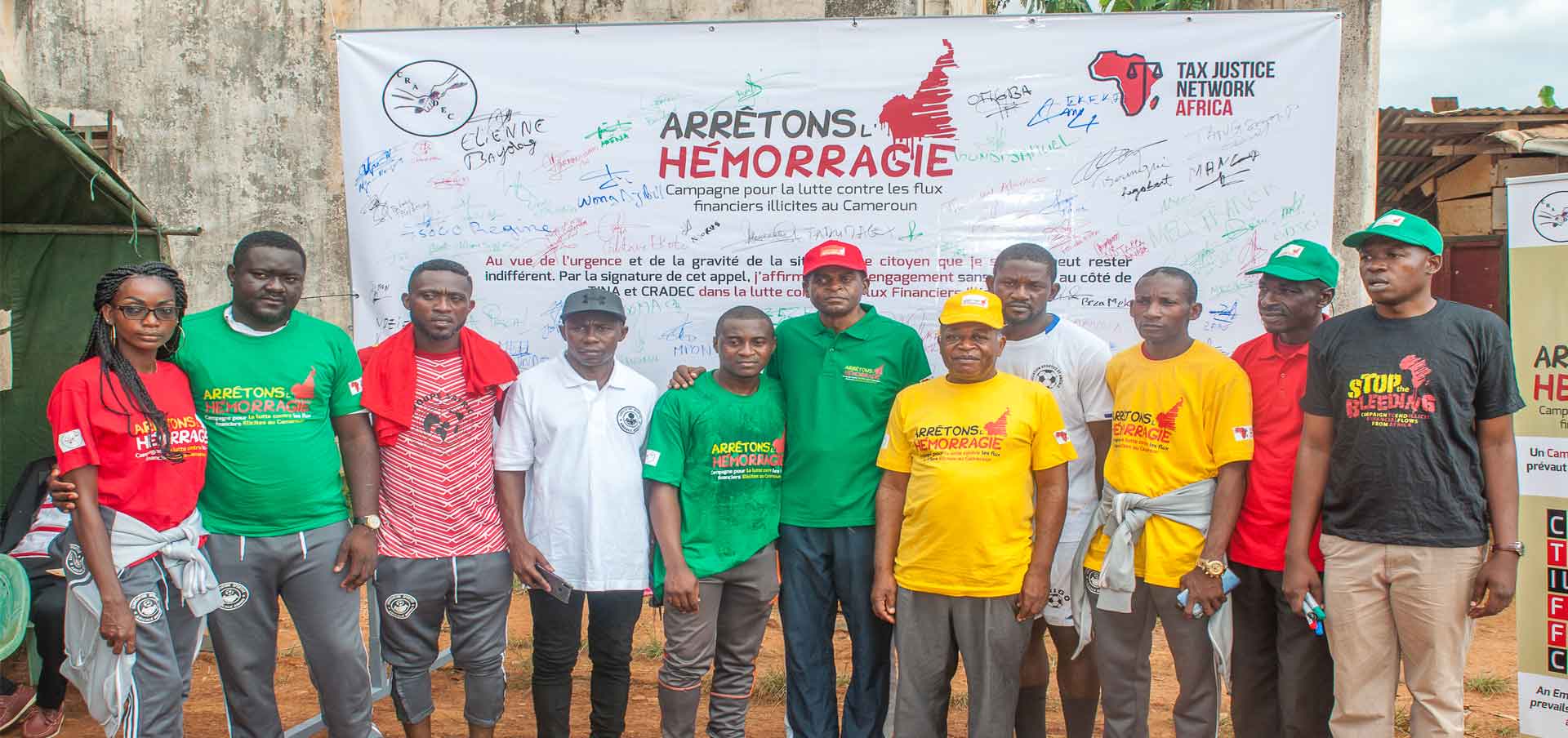
It is in this context that the African Regional Centre for Endogenous and Community Development (CRADEC), a recognised player in civil society, respectfully but firmly calls on the candidates: your mandate will only be credible and full of hope if it places tax justice, transparency and social equity at the heart of its action.
2025 PRESIDENTIAL ADVOCACY ACTION SHEETS
Tax justice and resource mobilization
Objective: To guarantee equitable and sustainable resources to finance development
Issue :
· Less than 20% of the working population actually contributes to taxes.
· VAT (19.25%) represents the largest share of revenue, hitting poor households more than richer ones.
· Oil and mining revenues, which constitute nearly 20% of budgetary revenue, remain opaque and poorly redistributed.
Proposed measures:
· Broaden the tax base by introducing a simplified regime for small traders, artisans and service providers in the informal sector.
· Reform extractive taxation by systematically publishing mining/oil contracts and revenues in accordance with the EITI.
· Digitize tax administration through mobile payments and online platforms to reduce intermediaries and corruption.
Expected impact:
· +30% tax revenue within 5 years, without increasing the burden on poor households.
· Reduction of dependence on external aid (currently around 20% of the investment budget).
· Stable funds for education, health and local infrastructure.
Example of application:
· Rwanda introduced progressive taxation for small businesses and digitized its procedures. As a result, tax revenue increased by 60% between 2010 and 2017.
Prevention and fight against corruption
Objective: Restore citizen trust through honest governance
Issue :
· Every year, corruption causes the national budget (CONAC) to lose around 500 billion FCFA.
· Article 66 of the Constitution (declaration of assets) is still not applied.
· Journalists and whistleblowers are exposed to reprisals.
Proposed measures:
· Make the declaration of assets and property of public officials mandatory and public.
· Create an independent monitoring body with the power to impose sanctions.
· Adopt a specific law to protect whistleblowers and guarantee freedom of the investigative press.
Expected impact:
· Reduction of embezzlement and overcharging in public procurement.
· Increased confidence among citizens and investors.
· Cameroon's ranking in the Corruption Perception Index (Transparency International) improves.
Example of application:
Cape Verde publishes the assets of its officials every year and ranks among the least corrupt countries in Africa.
Fight against Illicit Financial Flows (IFF)
Objective: To keep in Cameroon the wealth produced by Cameroonians
Issue :
· In 2023, nearly 1,700 billion FCFA left the country illicitly, more than the annual budget for education and health combined.
· The control bodies (ANIF, customs) lack resources.
· Shell companies and offshore accounts facilitate tax evasion.
Proposed measures:
· Strengthen the capacities of ANIF, customs and financial justice (training, budget, equipment).
· Toughen anti-money laundering legislation with effective sanctions against fraudsters.
· Create a public register of beneficial owners to track the true owners of companies.
Expected impact:
· 40% reduction in illicit capital in 5 years.
· Recovery of resources to finance social services.
· Better financial credibility of Cameroon internationally.
Example of application:
· Nigeria established a beneficial ownership register in 2021, which has helped curb money laundering and increase business transparency.
Gender equality and youth inclusion
Objective: To unlock the full potential of the population by making opportunities accessible to all.
Issue :
· Women represent more than 52% of the population, but less than 10% of the deputies in the National Assembly.
· Less than 15% of women have access to bank credit.
· Public policies still integrate the gender approach too weakly.
Proposed measures:
· Adopt a law on parity by establishing a minimum quota of 30% of women and young people in elected and appointed bodies.
· Institutionalize gender-responsive budgeting (GRB) in all administrations.
· Establish a national fund to support projects by women and young entrepreneurs.
Expected impact:
· Greater representation and participation of women and young people in governance.
· Reduction of social and economic inequalities.
· More inclusive and sustainable economic growth.
Example of application:
Senegal introduced a parity law in 2010, which made it possible to reach nearly 43% of women deputies by 2012.
Cameroon now has the opportunity to break with half-measures and build strong, equitable, and inclusive governance. Citizens expect their future president to undertake ambitious reforms, not to please donors, but to restore Cameroonians' confidence and offer a better future for future generations.
CANDIDATE, THIS PLEA IS A CALL TO ACTION.
YOUR ADHERENCE TO THESE RECOMMENDATIONS CAN MAKE THE DIFFERENCE BETWEEN CONTINUED BLOCKADES AND THE EMERGENCE OF A MORE JUST AND PROSPEROUS CAMEROON.
The Executive Director of CRADEC
Jean MBALLA MBALLA